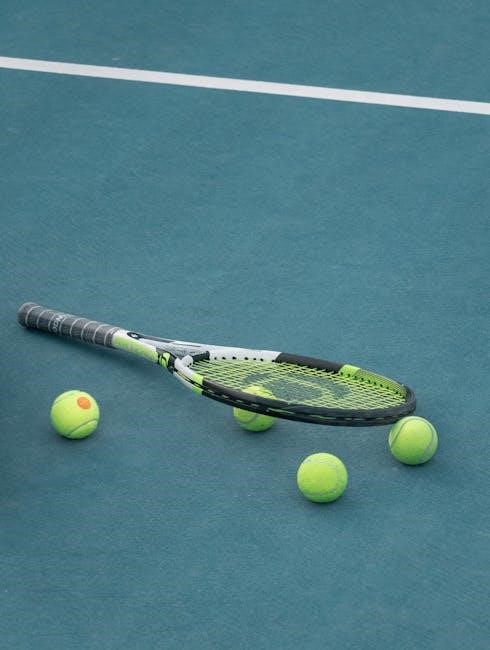
tennis racquet grip size guide
Selecting the correct tennis racquet grip size is crucial for comfort, performance, and injury prevention. Italian tennis news sites highlight equipment importance, while Volkl offers 4 1/2 ft grips.
Why Grip Size Matters
Grip size profoundly impacts a player’s control and power on the court. An appropriately sized grip allows for a relaxed handhold, maximizing wrist snap and generating greater racquet head speed. Conversely, an incorrect grip size – whether too small or too large – can lead to a tense grip, restricting natural movement and diminishing shot effectiveness.
Italian tennis portals emphasize the importance of proper equipment, indirectly highlighting grip size as a foundational element. Choosing the right size minimizes strain, enabling players to focus on technique and strategy. Furthermore, a comfortable grip enhances feel for the ball, improving shot placement and overall consistency. Ignoring grip size can compromise performance and potentially contribute to injuries.
Impact on Performance and Injury
An ill-fitting grip directly affects performance and increases injury risk. A grip that’s too small forces players to grip the racquet tighter, leading to forearm and elbow strain – potentially contributing to tennis elbow, as chronic management sometimes requires surgical treatment. Conversely, a grip that’s too large limits wrist action, reducing control and power.
Italian sports news sources mention surgical treatments for tennis-related issues, underlining the importance of preventative measures like proper grip selection. Choosing the correct size promotes a relaxed grip, allowing for optimal racquet head speed and minimizing stress on joints and tendons. Prioritizing grip size is a proactive step towards a healthier and more effective game.

Understanding Grip Size Measurements
Grip sizes are expressed in fractions of an inch (e.g., 4 1/4, 4 3/8) or millimeters. Volkl racquets, for example, are available in 4 1/2 ft grip sizes.
Fractional vs. Metric Grip Sizes
Tennis racquet grip sizes are traditionally measured in fractions of an inch, a system deeply ingrained in the sport’s history. Common sizes range from 4 1/8 inches to 4 5/8 inches, increasing in 1/8-inch increments. However, a growing number of manufacturers are also providing metric measurements, typically in millimeters, to cater to a wider international audience.
Converting between the two systems requires a simple calculation: 1 inch equals 25.4 millimeters. Therefore, a 4 1/4-inch grip is approximately 108 millimeters. While most players familiar with the US system stick to fractional measurements, understanding the metric equivalent can be helpful when purchasing racquets from European brands or when encountering specifications online. Ultimately, the numerical value is less important than how the grip feels in your hand.
Standard Grip Size Chart
Here’s a general guideline for standard tennis racquet grip sizes, though individual preferences vary significantly. Players with smaller hands typically find a 4 1/8 or 4 1/4-inch grip comfortable, while those with average-sized hands often prefer a 4 3/8 or 4 1/2-inch grip. Larger hands generally require a 4 5/8 or even larger grip size.
Below is a simplified chart:
- Hand Length (inches): 6.75 – 7.25: 4 1/8 ⎻ 4 1/4
- Hand Length (inches): 7.25 – 7.75: 4 3/8 ⎼ 4 1/2
- Hand Length (inches): 7.75 – 8.25: 4 5/8 ⎻ 4 3/4
Remember, this is a starting point. Factors like grip style (Continental, Eastern, Western) and personal preference play a crucial role in determining the ideal grip size. Volkl racquets, for example, are available in a 4 1/2 ft grip.

Determining Your Ideal Grip Size
Finding the perfect grip involves measuring your palm and testing with a racquet; consider hand size and strength for optimal control and comfort on the court.
The Palm Measurement Method
Accurately measuring your palm is a foundational step in determining your ideal tennis racquet grip size. Begin by placing your dominant hand flat on a table, fingers together. Use a ruler to measure the distance from the bottom crease of your palm to the tip of your ring finger.
This measurement, in inches, directly correlates to a recommended grip size. Generally, measurements between 3 3/4″ to 4 1/4″ suggest grip sizes ranging from 4 1/8″ to 4 5/8″. Remember, this is a starting point; individual preferences and factors like hand strength influence the final choice.
Italian tennis resources emphasize personalized equipment selection, and understanding your hand dimensions is key to that process. Consider repeating the measurement a few times to ensure accuracy before proceeding.
The Grip Test with a Racquet
The racquet grip test provides practical confirmation of your ideal size. Hold a racquet with your dominant hand, as if preparing for a forehand. Observe the space between your fingertips and the heel pad of your hand.
Ideally, you should be able to comfortably fit approximately one finger’s width (around 8-10mm) into this space. If the space is significantly larger, the grip is likely too small. Conversely, if your fingers feel cramped or overly compressed, a larger grip is needed.
Remember, Volkl racquets offer various grip sizes, and finding the right fit is crucial. This test, combined with the palm measurement, offers a well-rounded approach to grip selection, enhancing comfort and control on the court.
Considering Hand Size and Strength
Hand size and grip strength significantly influence optimal racquet grip selection. Larger hands generally require larger grips, providing sufficient fullness for a secure hold and preventing slippage. Smaller hands benefit from smaller grips, promoting better control and maneuverability.
However, grip strength also plays a role. Players with stronger grips may prefer a slightly smaller size for enhanced feel and wrist action. Conversely, those with weaker grips might opt for a larger grip to compensate and maintain control.
Remember, Volkl racquets come in various sizes, and finding the balance between hand size and strength is key to maximizing performance and minimizing strain.
Grip Sizes for Different Player Levels
Grip size recommendations vary based on skill level; beginners often start with larger grips for control, while advanced players may prefer smaller grips for feel.
Beginner Grip Size Recommendations
For novice tennis players, prioritizing comfort and control is paramount. Generally, a grip size between 4 1/4 and 4 3/8 inches is a solid starting point. These larger grips facilitate a relaxed hold, reducing tension and allowing for fuller swings.
Beginners often generate less racquet head speed and benefit from the added leverage a larger grip provides. It’s also easier to learn proper technique without battling an uncomfortable grip.
However, avoid excessively large grips, as they can hinder wrist movement and make it difficult to generate spin. Consider the hand size; smaller hands may benefit from the lower end of the range (4 1/4), while larger hands might lean towards 4 3/8. Remember, a comfortable grip is key to enjoying the learning process and building a solid foundation.
Intermediate Player Grip Size
As players progress beyond the beginner stage, grip size becomes more nuanced. Intermediate players, developing more racquet head speed and spin, often find a grip between 4 3/8 and 4 1/4 inches optimal. This allows for greater feel and control while still providing sufficient leverage for powerful shots.
Experimentation is crucial at this level. Players should assess how the grip impacts their ability to generate topspin and maintain a comfortable, yet secure, hold during aggressive swings.
Consider hand strength; stronger players may prefer a slightly smaller grip for enhanced feel, while those with less developed hand strength might benefit from staying closer to 4 3/8 inches. Italian tennis resources emphasize personalized equipment choices, and Volkl’s offerings cater to varied preferences.
Advanced Player Grip Size Considerations
Advanced players typically have a refined understanding of their equipment needs. Grip size at this level is highly individualized, often leaning towards smaller grips – 4 1/4 inches or even 4 1/8 inches – to maximize feel and racquet control. This allows for precise shot-making and enhanced maneuverability.
However, advanced players also possess the hand strength to maintain control with smaller grips. They frequently utilize overgrips to customize the feel and build up the grip to their exact preference.
Chronic management and surgical treatments, as mentioned in some resources, highlight the importance of proper technique and equipment. Italian tennis portals emphasize continuous improvement, and finding the perfect grip is a key component.
Overgrip and Undersizing/Oversizing
Overgrips modify grip size and absorb moisture. Players may undersize for enhanced feel or oversize for comfort and power, tailoring the racquet to their needs.
The Role of Overgrip in Grip Size
Overgrips are a fundamental component in customizing a tennis racquet’s grip. They don’t fundamentally change the base grip size, but they add a layer of cushioning and, crucially, circumference. This allows players to effectively increase the grip size without permanently altering the racquet. Different overgrip thicknesses exist, offering varying degrees of build-up.
A thicker overgrip will naturally result in a larger overall grip size, while a thinner one will have a minimal impact. Players often use overgrips to compensate for slight discrepancies in their base grip size or to achieve a preferred level of tackiness and comfort. Regularly replacing the overgrip is also vital, as it absorbs sweat and loses its grip properties over time, impacting performance and potentially leading to adjustments in grip size perception.
Undersizing a Grip for More Feel
Some players intentionally choose to undersize their racquet grip, believing it enhances their feel for the ball and improves racquet control. This approach allows for a more direct connection to the racquet, potentially increasing sensitivity and maneuverability. However, undersizing requires careful consideration, as it can also lead to gripping the racquet too tightly.
A tighter grip restricts wrist movement and can contribute to tennis elbow or other arm injuries. When undersizing, players typically compensate by adding multiple layers of overgrip to achieve a comfortable and secure hold. It’s a technique favored by players prioritizing finesse and touch over raw power, seeking a heightened sense of racquet head feel during contact.
Oversizing a Grip for Comfort and Power
Conversely, some players opt for an oversized grip, prioritizing comfort and the potential for increased power. A larger grip can be beneficial for individuals with larger hands or those who naturally grip the racquet with more force. It reduces the tendency to squeeze the handle excessively, minimizing strain on the forearm muscles and potentially lowering the risk of tennis elbow.
However, an overly large grip can diminish feel and control, making it harder to generate spin and finesse shots. Players often use fewer layers of overgrip with an oversized base grip, or none at all, to maintain a secure hold. Volkl racquets, for example, are available in various grip sizes to accommodate different preferences.
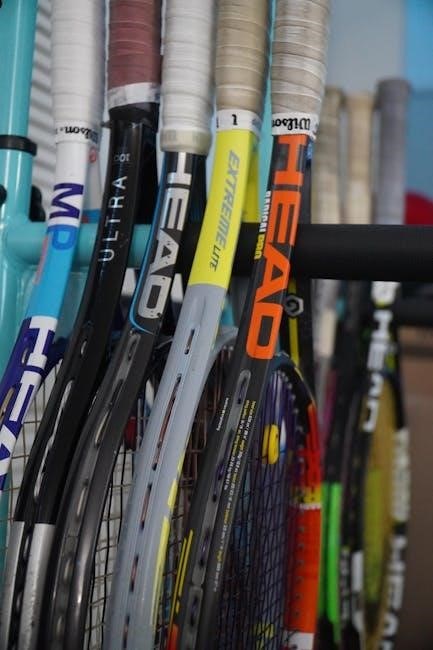
Common Grip Size Mistakes
Incorrect grip size frequently leads to technique flaws and injuries. Choosing too small or too large a grip impacts control, power, and can contribute to tennis elbow development.
Using a Grip That’s Too Small
Employing a grip that’s undersized can significantly compromise your tennis game and physical well-being. When the grip is too small, players instinctively grip the racquet tighter to compensate for the lack of substantial feel and control. This excessive squeezing leads to forearm muscle fatigue and increased stress on the elbow joint, potentially contributing to conditions like tennis elbow.
Furthermore, a smaller grip restricts wrist movement, hindering the ability to generate topspin and execute various shot types effectively. Players may experience discomfort, cramping, and reduced power output. The need to constantly tighten the grip also diminishes feel for the ball, impacting precision and overall shot consistency. Ultimately, a grip that’s too small forces players to work harder, increasing the risk of injury and limiting their potential.
Using a Grip That’s Too Large
Conversely, a tennis racquet grip that’s too large presents its own set of challenges and drawbacks for players. An oversized grip can hinder wrist flexibility, making it difficult to generate racquet head speed and impart spin on the ball. Players may find themselves unable to comfortably close their hand around the grip, leading to a loose and unstable feel.
This lack of control can result in inaccurate shots and diminished power. Additionally, a larger grip can promote an improper grip technique, encouraging players to rely more on arm strength than proper form. This can exacerbate existing issues or create new ones, impacting long-term development. Ultimately, an overly large grip can feel cumbersome and restrict natural swing mechanics, hindering performance.
Symptoms of an Incorrect Grip Size
Recognizing the signs of an ill-fitting grip is vital for preventing discomfort and potential injury. Several symptoms can indicate your grip size isn’t optimal. These include experiencing excessive tension in the forearm and hand during play, leading to fatigue and potential tennis elbow – a concern highlighted in discussions about grip size and injury prevention.
Difficulty generating spin, a feeling of instability or lack of control, and frequent mishits are also common indicators. Players might unconsciously tighten their grip to compensate, further exacerbating tension. Blisters or calluses forming in unusual places on the hand can also signal a problem. Addressing these symptoms promptly is crucial for maintaining a healthy and enjoyable tennis experience.

Specific Racquet Brands and Grip Sizes
Wilson, Head, and Babolat offer varied grip sizes within their racquet lines. Volkl provides a 4 1/2 ft grip option, impacting feel and control.
Wilson Racquet Grip Size Guide
Wilson racquets generally adhere to standard grip sizing, offering options ranging from 4 1/8 inches to 4 5/8 inches and beyond, often in 1/8-inch increments. Determining the correct Wilson grip size involves considering hand size and playing style. Players with smaller hands typically benefit from smaller grips, enhancing control and maneuverability. Conversely, those with larger hands may prefer larger grips for increased power and stability.
Wilson’s grip sizes are frequently indicated numerically, alongside the inch measurement. It’s important to note that overgrips can effectively increase a racquet’s grip size, allowing for customization. Wilson’s website and retailer resources provide detailed charts correlating hand measurements to recommended grip sizes, ensuring a comfortable and effective playing experience. Proper grip size minimizes strain and maximizes performance on the court.
Head Racquet Grip Size Guide
Head racquets, like Wilson, utilize a standard grip sizing system, typically ranging from 4 1/8 to 4 5/8 inches, with incremental increases of 1/8 inch. Selecting the appropriate Head grip size is paramount for optimal control and comfort. Smaller grips (4 1/8 ⎻ 4 1/4) suit players with smaller hands, promoting a quicker wrist action and enhanced feel for the ball.
Larger grips (4 3/8 ⎼ 4 5/8) are generally favored by players with larger hands, providing greater leverage and power. Head often provides grip size recommendations based on hand length measurements. Remember that adding an overgrip will increase the effective grip size. Consulting Head’s official resources or a knowledgeable tennis professional can ensure a personalized and effective grip selection for peak performance.
Babolat Racquet Grip Size Guide
Babolat, a leading racquet manufacturer, adheres to industry-standard grip sizing, offering sizes from 4 1/8 to 4 5/8 inches, increasing in 1/8-inch increments. Determining the correct Babolat grip size is vital for maximizing control and minimizing strain. Players with smaller hands often benefit from smaller grips, enhancing maneuverability and feel, similar to Head’s recommendations.
Conversely, larger grips provide increased stability and power for players with larger hands. Babolat’s website and retailers often provide grip size charts based on hand measurements. Remember to factor in overgrips, which effectively increase grip circumference. Seeking guidance from a tennis professional ensures a personalized fit, optimizing performance and reducing the risk of tennis elbow, a concern highlighted in related tennis health discussions.

Grip Size and Tennis Elbow
Incorrect grip size significantly contributes to tennis elbow; too-small grips force excessive muscle tension, while too-large grips reduce wrist flexibility, increasing injury risk.
How Grip Size Can Contribute to Tennis Elbow
Tennis elbow, or lateral epicondylitis, is often linked to improper technique, but grip size plays a substantial role. A grip that’s too small compels players to grip the racquet tighter to maintain control, leading to increased stress on the forearm muscles and tendons. This excessive squeezing generates micro-tears, initiating the inflammatory process. Conversely, a grip that’s too large can limit wrist movement, forcing the forearm to compensate and absorb more shock during ball impact;
This compensation also increases muscle strain. Chronic management, including surgical treatment, may be needed if conservative approaches fail after 6-12 months. Choosing the right grip size isn’t merely about comfort; it’s a proactive step towards preventing this painful condition and maintaining long-term tennis enjoyment.
Choosing a Grip to Minimize Tennis Elbow Risk
Selecting an appropriate grip size is paramount in mitigating tennis elbow risk. Prioritize a grip that allows for a relaxed handhold – you shouldn’t need to squeeze excessively. If you’ve experienced tennis elbow, slightly undersizing the grip (with overgrip additions) can reduce forearm strain by promoting better wrist snap and shock absorption. However, avoid going too small, as this can lead to over-gripping.
Consider professional restringing services to ensure proper tension, further reducing impact forces. Remember that chronic issues may require surgical intervention after prolonged conservative treatment. Regularly assess your grip and adjust as needed, prioritizing comfort and a relaxed grip throughout play.

Changing Your Grip Size
Adjusting grip size requires a gradual approach; avoid sudden changes. Re-gripping your racquet is essential, and professional services offer expert restringing and grip application.
Gradual Adjustments are Key
Transitioning to a new grip size should never be abrupt. Your hand needs time to adapt to the altered feel and dimensions. A sudden shift – whether increasing or decreasing – can disrupt your technique and potentially lead to discomfort or even injury. Instead, opt for incremental changes.
If you’re undersizing, move up only 1/8 of an inch at a time. Similarly, when oversizing, proceed in small increments. Allow several hitting sessions with each new size before evaluating its impact. Pay close attention to how your hand feels during play, noting any changes in control, power, or comfort. Remember, finding the perfect grip is a personalized process, and patience is paramount. Consistent, small adjustments will yield the best results.
Re-gripping Your Racquet
Regularly re-gripping your racquet is essential, regardless of your chosen grip size. Over time, the original grip absorbs moisture and wear, becoming slick and compromising your control. A fresh grip restores tackiness and enhances your connection to the racquet. Consider how often you play; frequent players may need to re-grip weekly, while occasional players can extend this to monthly or bi-monthly.
You can re-grip your racquet yourself with readily available grip tape, ensuring a smooth, even application. Alternatively, professional restringing services often include re-gripping, guaranteeing a precise and durable result. Maintaining a consistent grip condition is just as important as selecting the correct size for optimal performance and comfort.
Professional Restringing and Grip Services
Entrusting your racquet to professionals offers significant benefits beyond simply re-gripping. Skilled technicians assess your racquet’s condition, identifying potential issues needing attention. They expertly remove the old grip, thoroughly clean the handle, and apply the new grip with precision, avoiding bubbles or unevenness.

Restringing services are equally crucial; proper string tension dramatically impacts performance and feel. Professionals utilize specialized machines to achieve accurate tension, tailored to your playing style. Combining restringing with a re-grip ensures your racquet is optimized for play. While DIY options exist, professional services guarantee quality and longevity, maximizing your investment and enjoyment on the court.


Leave a Reply
You must be logged in to post a comment.